Slovenian Folk Songs II: Legendary Songs, I
SLP II, p. 13, s. No. 68/27
GNI M 28.762
Sung by: Ana Rezec (1913), Helena Vrečko (1915), Terezija Flis (1928), Martin Rezec (1937), Franc Rezec (1917) and Ivan Razboršek (1934)
Recorded: 1968
There are two songs in the Slovene tradition about Adam and Eve: a legendary one about the first sin and banishment from paradise, and another jocular one. Similar songs are also known in the German tradition; therefore, it is assumed that one of these could be a template for ours. The earliest published German songs are from the 19th century, and our son cannot be older. This is also indicated by the structure of the verse.
This song is represented on the audio publication by a three-part pattern, where the two-line melody is repeated in accordance with the stanza so that the refrain is sung in the repetition. Women’s two-part singing in thirds is accompanied by men’s bass singing.
SLP II, p. 16, s. No. 69/6
GNI M 28.191
Sung by: Katarina Sušnik (1886)
Recorded: 1967
The Old Testament of the Holy Bible contains an instructure story about the honest Job, who must but his faithfulness to God on trial by giving up all of his possessions, his children, and his health. Because he does not turn away from God, Job is finally given back what he lost. Our song is based on this story. By the form of its verses and melody, it belongs to an older tradition. In the folk tradition of Western Europe, Job is the patron saint of musicians, adn in Slovenia he is the patron saint of beekeepers. Both are reflected in pictures of beehive front panels. These drew from songs for inspiration, as a woman is painted on many of them to whom “wasps were let off into her hair”, as we are told by the last stanza of the sound example on the audio publication.
The meoldy of this example contains only two lines in 3/8 time signature without a pause between them.
cf. SLP II, s. No. 75
GNI M 28.017
Sung by: Ludva Kranjc, Jakob Turšič and Tone Kranjc
Recorded: 1966
cf. SLP II, s. No. 75
GNI M 28.017
Sung by: Ludva Kranjc, Jakob Turšič and Tone Kranjc
Recorded: 1966
An example of how our ancestors saw Mary as the mother of the human Jesus and as the mother of God. As such, while cradling her child she is granted the power to turn a dry tree green.
The example on the audio publication was recorded after the publication of SLP II, for which reason it is not published in the book. It is interesting as an example where men also sing narrative songs in the characteristic three-part arrangement (leading voice, “over”, and bass) in a rubato rhythm, and mostly in 5/8 measure.
SLP II, p. 64, s. No. 77/11
GNI M 29.092
Sung by: Marija Belina (1903)
Recorded: 1968
SLP II, p. 64, s. No. 77/11
GNI M 29.092
Sung by: Marija Belina (1903)
Recorded: 1968
This song is in fact a versified legend called “Why does the dove hold her head aside”, and the story begins with Mary’s need for a nurse for her child so that she could realize her (perfectly human) wish to go to a wedding.
The melody presented on the audio publication is made up of four lines. It runs in rubato rhythm, which nevertheless exhibits an alternation of 3/8 and 5/16 measures.
SLP II, p. 72, s. No. 77/15
GNI M 25.462
Sung by: Luigia Di Floriano and Ana Di Floriano (1887)
Recorded: 1962
SLP II, p. 72, s. No. 77/15
GNI M 25.462
Sung by: Luigia Di Floriano and Ana Di Floriano (1887)
Recorded: 1962
In Resia, the legendary motif about a little bird that offered to Mary to be her nursery-maid during a short time away from home had grown into a long song with several events. The great number of recordings shows that in the 1960s, this song was thriving, although not every singer knew the entire song by heart. The example presented here is also one of the shorter versions. A special feature of the variant from Resia comes from its story, where during Mary’s absence “wicked Jews” stole the baby Jesus, whom Mary finds only after a long search and various experiences.
We have taken, as an example of variants from Resia, a recording made in the village of Liščace. The melody of this example has a characteristically narrow range. Two-part singing in the third and the 6/8 measure may be a sign of the influence of singing from neighboring Friuli and the remaining Slovene territory.
SLP II, p. 98, s. No. 78/2
GNI M 29.548
Sung by: Giovanni Michelizza and Maria Michelizza
Recorded: 1968
SLP II, p. 98, s. No. 78/2
GNI M 29.548
Sung by: Giovanni Michelizza and Maria Michelizza
Recorded: 1968
This is the only example in the Slovenian folk song tradition that mentions the river Rhein. From this we may assume that it originates from a time when Slovenes still made pilgrimages to the Rheinland. The singer’s clarification that Mary suffers from a headache because the raging river will flood many villages permits the hypothesis that this song, in its own way, deals with villages flooded because Mary was not given shelter for the night.
The melody in this example consists of two lines in two-part singing in the third, which rings out in unison.
cf. SLP II, s. No. 90
GNI M 33.904
Sung by: Sidonija Gašpar (1908)
Recorded: 1972
cf. SLP II, s. No. 90
GNI M 33.904
Sung by: Sidonija Gašpar (1908)
Recorded: 1972
This type of song might be a reminder of the apocryphal stradition. It draws upon the old Biblical idea of the root of Jesse, from which a shoot will sprout, illustrated in Medieval mysticism by a tree growing from the heart of the sleeping Mary. In the Orthodox church, this tradition has been preserved, for example, among Balkan Slavs. But the Slovene song ascribes dreams to the sleeping Mary: in these, Mary sees the “mladi krav” (the young king) Jesus Christ sitting with a sword in his hand in Heaven. Since in our tradition Mary is seen as the omnipotent mediator, she dares to beg God to mitigate or to abandon the Day of Judgement. The present recording is an example of the phenomenon where the stanza of the text must be repeated in order to embrace a melody of several lines.
SLP II, p. 246, s. No. 105/151
GNI M 29.083
Sung by: Anton Leva (1914), Alojzija Leva (1914) and Antonija Polanec (1911)
Recorded: 1968
SLP II, p. 246, s. No. 105/151
GNI M 29.083
Sung by: Anton Leva (1914), Alojzija Leva (1914) and Antonija Polanec (1911)
Recorded: 1968
The song about a ferryman who refuses to ferry Mary across the river unless she pays him money is one of the most-preserved and widespread Slovene narrative songs, possibly because it was also sung when keeping vigil over a deceased person. In the Karst region, it used to be a very common central part of Christmas carols. The song spread from Slovenia to Croatia; it is also known in the German tradition, but it is unknown elsewhere in Europe. In some places, the text is related to the song about Mary’s change of abode or about Mary and pilgrims. The three-part melody of the example on the audio publication moves in alternating 3/4 and 4/4 measures.
SLP II, p. 280, s. No. 106/32
GNI M 20.632
Sung by: Ančka Cencelj and Francka Pistotnik
Recorded: 1957
SLP II, p. 280, s. No. 106/32
GNI M 20.632
Sung by: Ančka Cencelj and Francka Pistotnik
Recorded: 1957
This song voices the idea that a modest and benevolent man is morally superior to a boastful, hard-hearted rich man. A similar legend of similar content is also known among the Irish, but not among other European nations. Was it possible that Irish monks active as missionaries among Slovenes passed on the folkloric material to Slovenes after settling here? Might the song originate from the Medieval times?
As an example of this very widely-spread song, a case is given where the two-part melody, sung in thirds, comprises only two lines in the alternating 3/4 and 2/4 measures.
SLP II, p. 288, s. No. 106/46
GNI M 31.755
Sung by: A group of female singers led by Julija Bajzek 81918)
Recorded: 1970
SLP II, p. 288, s. No. 106/46
GNI M 31.755
Sung by: A group of female singers led by Julija Bajzek 81918)
Recorded: 1970
To illustrate how a song’s text and melody can vary regionally, we have added an example from Porabje.
As with the previous song, the melody here is in alternating 3/4 and 2/4 measures, yet it comprises three lines and moves in two-part sung sixths.
cf. SLP II, s. No. 108
GNI M 39.809
Sung by: Rozalija Ofič (1915)
Recorded: 1981
cf. SLP II, s. No. 108
GNI M 39.809
Sung by: Rozalija Ofič (1915)
Recorded: 1981
The origin of this song, which is still widely-known and sung, may go back to half a millennium. In may variants, it is said that Mary is fleeing from Hungary, from the people desecrating her churches: from Calvinists at the time of the Reformation. In more recent variants, she moves from one parish to another because she has not been paid due homage, or she leaves the altar in her church and goes to the belfry.
The melody presented on the audio publication is in four lines in alternating 3/4 and 2/4 measures.
SLP II, p. 313, s. No. 108/44
GNI M 25.019
Sung by: The Kapus brothers
Recorded: 1962
This recording is interesting as an example of legendary songs sung by men. The song is in several parts, with an added refrain unrelated ot the text but used only as a component element.
The melody consists of four lines. It is composed in a 3/4 measure, the measure is shortened in the transition from the second to the third line (followed by a refrain). This is one of many four-line melodies to be found before the fourth line.
SLP II, p. 363, s. No. 111/89
GNI M 24.541
Sung by: Marjana Žun and Lojzka Žun (1924)
Recorded: 1961
By the number of variants of this song, either written down or recorded, this song fits into the category of Mary and the Ferryman. It probably originated in the Middle Ages, possibly at the time when the Ave Maria prayer was standardized, and it had an interesting course of development. In the earliest variants, the bird heard a mermaid sing – half woman, half fish, often depicted in the sea, under St. Christopher’s feet, painted on the outer walls of many Slovene churches. Later on, the girl from the songs was replaced by angels, and more recently, by two masons. Whereas in some cases she is, in fact, a human girl who was thrown into the river by her step-mother and subsequently saved by Mary, in more recent variants the lyrics about two masons building a church are followed by lines from a sacred song about Christ’s words on the cross. The development of the form of this song is likewise interesting: The way of singing in several parts where the leading singer sings the first line or its beginning itself, after which it is repeated by all of them together, has become the rule for this song. This style is also present when only one singer performs the song. Also in the version presented on the audio publication, the beginning of each verse is sung by one singer only, while the second one joins her in the third verse. A special feature of this example is the unequal alternation of measures.
SLP II, p. 393, s. No. 118/9
GNI M 25.308
Sung by: Jožefa Spruk
Recorded: 1962
The story of this song comes from an old tradition according to which St. Thomas should go as a missionary to india. But the places to which Jesus sends his other disciples refer to people worshipping of those disciples in those places; e.g. the mountain to which St. Primus goes stands for a pilgrimage church on the slopes of the highlands over Kamnik. On the audio publication, there is only one of the two melodies of this song that still exist. It consists of two lines in 4/8 measure.
SLP II, p. 401, s. No. 121/3
GNI M 30.058
Sung by: Julka Pernek (1928)
Recorded: 1969
The story of this song, written down or recorded only in Styria, has no original traces in either the Bible or in Medieval records. It appears that what we have here is simply an ingenious shaping of what comes from a pious imagination.
SLP II, p. 423, s. No. 125/8
GNI M 25.183
Sung by: Marija Ivančič (1916) and Tereza Ivančič (1913)
Recorded: 1962
This story is related to a Medieval legend: the good-hearted bishop Nicholas (In Slovene: Miklavž), coming from Myra in Asia Minor, had cut down a tree consecrated to the goddess Diana. The Devil wanted to take revenge upon him such that he gave pilgrims traveling by ship to Nicholas’ church magical oil intended to destroy the church. On their way, St. Nicholas appears and commands them to cast the oil into the sea. The story is written down in the 13th-century collection Legenda aurea, and it is also known in the Croatian tradition of the coastal belt from Istria to Dalmatia. In the Croatian part of Istria, a picture exists of St. Nicholas cutting down that tree. As St. Nicholas is also venerated in southern Italy, this particular traditional belief might have come to us from the Croatian side. A special feature of this song is the recitative manner of singing in two parts in thirds occasionally sounding in unison.
SLP II, p. 457, s. No. 127/78
GNI M 22.638
Sung by: Micika Šoštarič (1902) and Lujzika Žitek (1937)
Recorded: 1958
St. Bernard, the revitalise of the Cistercian order, was still alive when the first Cistercians came to Stična in 1136 and to Vetrinj near Celovec (Klagenfurt) in 1142. Considering the influence that spread from the abbey in Stična over the religious and cultural life of Slovenia ‘ due alreadz to the great number of parishes subordinate to the abbey – the origin of this song is probably related to Stična, whose church is consecrated to Mary. Biographers of St. Bernard say that in his young years he was a merry fellow, but later in life he became a great worshipper of the Mother of God. Is it for this reason that he meets Mary in the song after he has been whistling nicely and singing? Since, according to folk tradition, he does not belong among patron saints, over time his name got lost from the song, which today only mentions the “younglad”, thus for instance in the present, more recent recording.
The melody of the example on the present audio publication comprises only two lines, which are reiterated as the stanza of the next, making four lines.
cf. SLP II, s. No. 127
GNI M 42.952
Sung by: A group of female singers from Beltinci
Recorded: 1985
The multi-part melody offered on the audio publication flows in alternating 4/4 and 3/4 measures and is four lines long. The fourth line is repeated because the last verse of the stanza is repeated.
SLP II, p. 496, s. No. 128/56
GNI M 29.549
Sung by: Giovanni Michelizza, Maria Michelizza and Vittorio Sedola
Recorded: 1968
The text of this song refers to the legendary tradition about two saints bearing the same name and celebrating their name day on the same day in May: St. Isidore the farmer and patron of Madrid, who lived in the 12th century, and St. Isidore the warrior, whose relics were transferred to Venice in the 12th century. The song has existed in our tradition from at least the 16th century onwards. it soon became popular, and in various regions it has gone through major or minor changes in content.
The melody, recorded in Veneto, consists of two sound lines in 3/4 measures, the second of which is repeated with the second verse of the text.
cf. SLP II, s. No. 128
GNI M 45.211
Sung by: A group of male and female singers from Ludranski vrh
Recorded: 1988
This song has passed, in an abbreviated form, into schools and school songbooks. With its monotonous melody and refrain, it has become a song for children that is still preserved today as shown by this recording from 1988.
SLP II, p. 507, s. No. 130711
GNI M 23.681
Sung by: A group of female singers, lead singer: Francka Cene (1910)
Recorded: 1960
The worshipping of St. Anthony of Padua, a learned Franciscan preacher from the 13th century, started to spread in the 15th century. But it was only in the 17th and 18th centuries that he became a truly popular saint, a designation previously kept for St. Anthony the Hermit, who was linked with Hell, wickedness, and temptations in the folk tradition. Some of these attributes became associated with St. Anthony of Padua, as well as Saint Francis of Assisi’s legendary preaching to birds. In some variants, St. Anthony is a musician saving souls from Hell (like Orpheus in the ancient Greek tradition).
A special feature of the three-part example on this audio publication is the refrain, which is related to the story of the text and contains two lines of melody for the two-line stanza of the text.
SLP II, p. 533, s. No. 136/12
GNI M 23.453
Sung by: Cila Zore (1889), Terezija Zavasnik (1896) and Terezija Drolc
Recorded: 1960
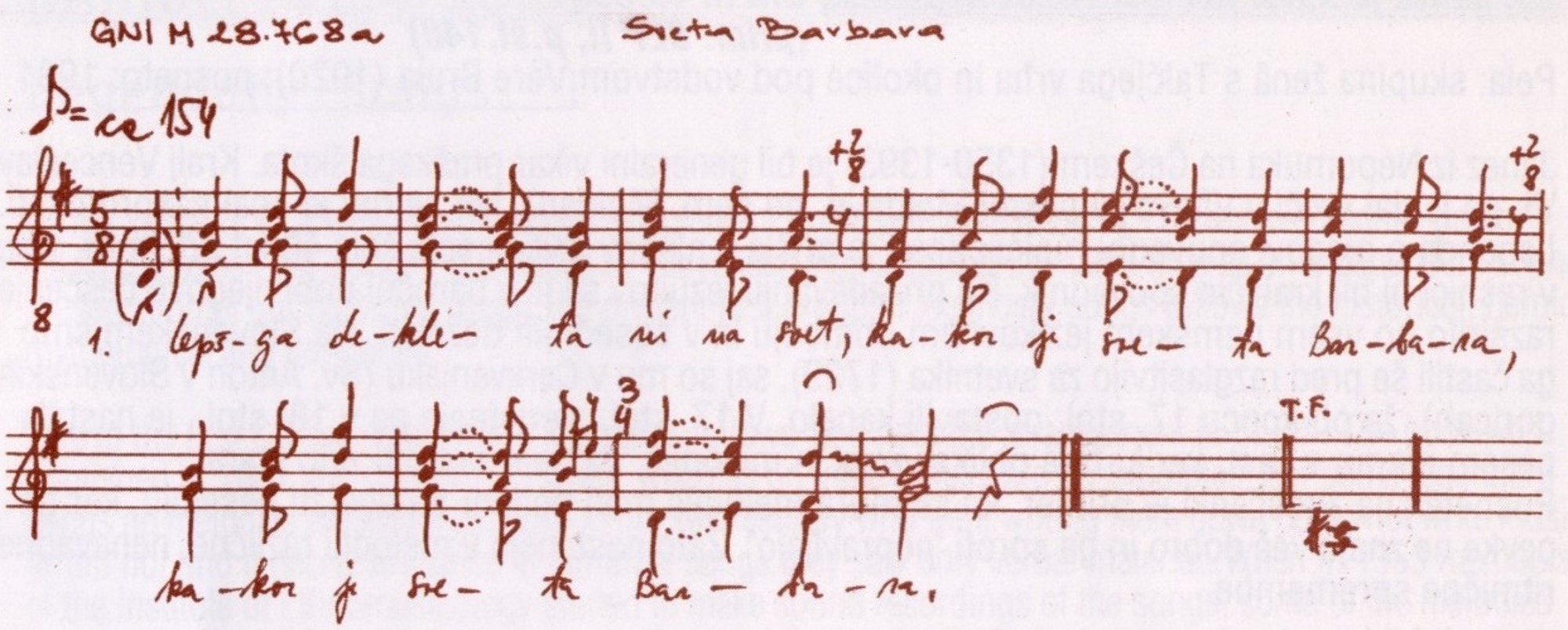
There is no historical evidence about St. Barbara, but according to tradition she would have been from Asia Minor and lived there from the third to fourth century. Because of her beauty, her father imprisoned her in a tower. When she professed the Christian faith, her father beheaded her. In Slovenia, almost every church has a statue of her, and her distinctive symbol is a church tower or a chalice. Since the song mentions that she was trapped in the tower because she did not want to marry the Spanish king, and since some variants are composed in the old Slovene verse formula (three-part octosyllabic verse) matched by a three-line melody with three measures in each line, it is assumed that this song, in our tradition, was solidified before the 15th century, from which it carried over to our times.
The text of the recording on the audio publication is also arranged in the aforementioned verse formula with a suitable melody in 3/4 measure. However, it also contains a feature indicating the typical Slovene inclination toward a five-part period, i.e. a group of three quavers frequently changes into 5/16, hence the quaver in the middle is shortened.
SLP II, p. 538, s. No. 136/19
GNI M 28.768a
Sung by: Ana Rezec (1913), Helena Vrečko (1915) and Terezija Flis (1928)
Recorded: 1968
The second example of this type by content, according to its text and melody, corresponds to the three-part octosyllabic verse. At the end of the line, however, the female singers strayed from the course of the melody.
SLP II, p. 562, s. No. 139/6
GNI M 23.423
Sung by: Francka Demec and Julka Kastelic
Recorded: 1960
This song, according to its contents, is based on a legend from the 13th-century Legenda aurea collection, according to which Ursula was the daughter of the British king. The king wanted her to marry his son. Huns attacked her at Cologne on her way back from a pilgrimage to Rome, and because she refused to marry the king of the Huns, the king shot her. The legend has a grain of historical truth: Huns slaughtered fugitives from England on the Rhine in 451. Although St. Ursula is well-known among us and the name Ursula is a common female name, this song has all but disappeared.
The example on the audio publication is in fact a remnant of a longer song. The characteristic form is preserved, however: the three-verse stanza is sung with a two-line melody with a recurring second line. The 6/8 measure, however, is fairly rare in our tradition.
cf. SLP II, s. No. 140
GNI M 40.008
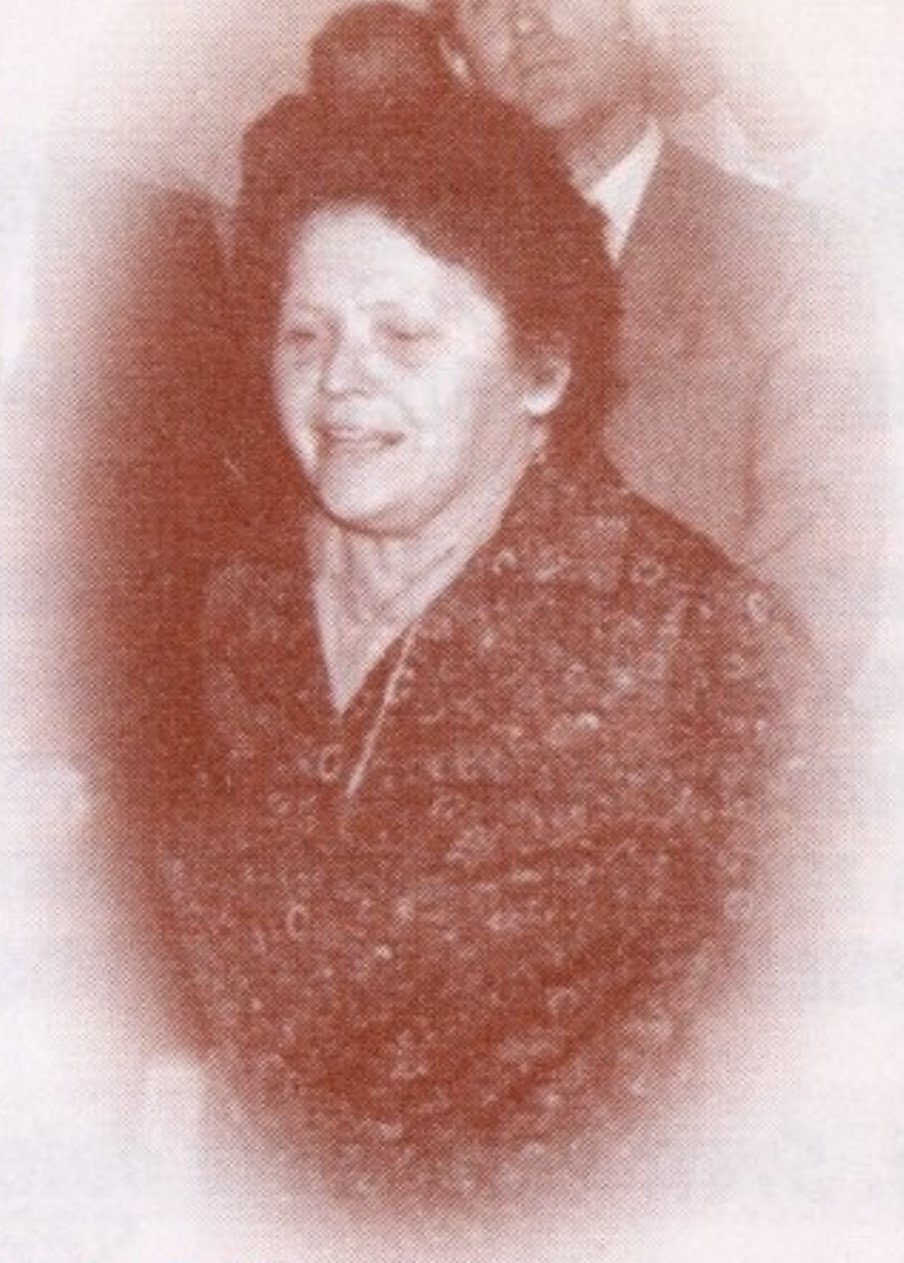
Sung by: A group of female singers from Talčji vrh and surroundings, singing was lead by Vera Brula (1920)
Recorded: 1981
Janez (John) from Nepomuk in the Czech lands (1350-1393) was the general vicar of the Bishop of Prague. King Wenceslas VI had him thrown into the Vltava (called Moldava in the song, after the German Moldau), because John dared to oppose him. The legend about his seal of confession entered into John Nepomuk’s buigraphy only 40 years after his death, for in fact he was the confessor of the queen. Through the endeavours of the Jesuits, the worshipping of St. John Nepomuk spread throughout the German-speaking and neighbouring territories during the Baroque period. In Slovenia, he was worshipped even before his proclamation as a saint in 1729: people built a chapel for him at Crvenjak (Sv. Anton in Slovenske Gorice) at the end of the 17th century.
A song in his honour was composed in the 17th or 18th century: both the verse and the melody of the song show that it cannot be very old. The recording on the audio publication is an example of how the melody has to be adapted to the text while singing. The singers do not know the melody very well and must “correct” it as they sing. This gives rise to various, unusual rhythmic changes in the melody.
Narrative Songs: Legendary Songs, I
In the series of audio publications offered as a sound supplement to the printed edition of “Slovenske ljudske pesmi” (SLP; Slovene Folk Songs) published by Slovenska matica, and at the same time as an independent sound presentation of our narrative songs, the present first group of legendary songs follows the historical, heroic, mythological and fairy ones.
Like in the first audio publication, the sequence of examples here also follows the arrangement in SLP II. The book was publishedin 1981 and contains 73 songs, where as on the audio publication there are 25 examples. For some legendary songs, no melodies are extant as those in the 19th century who were writing them down could not write music or did not find it necessary, since in narrative songs they saw only verbal material. When members of the Institute of Ethnomusicology started to make sound recordings of the songs in 1955, some of the melodies had already been forgotten, while some earlier recordings are technically too imperfect for publication today, Unfortunately, there are also flaws that could not be avoided in the more recent recordings (e.g. noise from the street nearby or other disturbances) or the example is not acceptable because of singing errors. If among the recordings published in the book there was no recording suitable for the audio publication, a more recent, unpublished example has been used. Although the recordings made in the field may, in their technical quality and singing perfection, fail to reach the achievement of studio recordings with professional singers, through their immediacy they are more convincing and more genuinely representative of our folk song tradition.
Legendary songs are ranked on par with others in the group of narrative songs and have no particulat role, except that some were sung when relatives and neighbours were staying awake as long as a dead person lay in state at home if singing was locally customary. Legendary songs do not differ from other Slovene songs: the construction of the text and melody and the way of singing remain consistent. These songs are sung by those who know them, either alone or in a group, for enjoyment and not for presentation to the listeners. Therefore, the audio publication brings examples of songs for one voice, two voices, or multi-part singing. The singers are men and women, old and young. Since some of these songs are found all over Slovenia, an attempt has been made to illustrate regional variants: at least two are presented where multiple exist.
Christianity, adopted by Slovenes soon after their settlement into the present-day Slovenian ethnic territory, is inseperable from Slovenian folk tradition. It is not only our land that is dotted with little church. Our song tradition is just as full of Christian symbols.
The contents of our legendary songs relate to Biblical stories, stories about saints, and in two examples, sermons. Some songs narrative stories about Jesus or Mary, others go back to the Old Testament or speak about the martyrdom of saints, their help in times of need, or punishment for sins. Some songs are related to visual motifs in church frecoes or Medieval mysticism. In some songs, the truth mixes with made-up stories and legendary motifs, while in others only the name of a saint connects the song to legends.
Slovenia was never cut off from the world: various spiritual currents crossed through our lands throughout history. Even if Slovenes adopted songs and stories from elsewhere, we shaped it according to our feelings and our views. It does seem that our creativity is permeated with an atmosphere of a certain domestic simplicity through which legendary events are placed into the Slovene provincial environment. In the Middle Ages as well as in the centuries that followed, when from the viewpoint of Christian unity Christendom was still a fairly unified territory, our people have also participated in the moulding of a European Christian culture.
Gallery